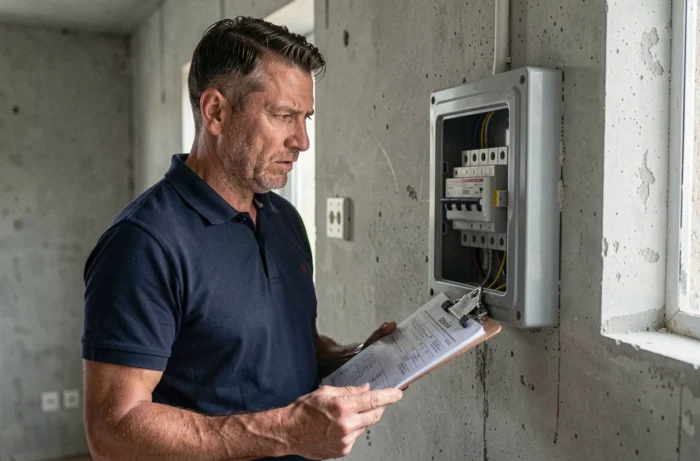
An entry or exit inventory conducted while the electrical meter is inactive poses a concrete problem: several checks become impossible. The issue goes beyond a simple technical inconvenience. It touches on the validity of the document, the distribution of responsibilities between landlord and tenant, and even criminal law when the cut is intentional.
Inventory with or without electricity: what changes concretely
| Verification | With electricity | Without electricity |
|---|---|---|
| Lighting (ceiling lights, wall sconces) | Functional test possible | Impossible to test |
| Electrical outlets | Test with device or tester | No verification |
| Electric roller shutters | Up/down test | Stuck in position |
| Electric cooktops | Heating test | Impossible |
| VMC / ventilation | Functionality check | No control |
| Intercom / digicode | Call test | Impossible |
| Condition of walls, floors, woodwork | Correct visual inspection | Degraded inspection (dim light) |
The table highlights a point often underestimated: without power, the majority of the housing equipment escapes control. The condition of the walls and floors can be observed in natural light, but as soon as a room lacks windows (bathroom, pantry, hallway), even basic visual inspection becomes unreliable.
The possibility of conducting an inventory without electricity exists legally, but the document produced will be incomplete and potentially contestable by either party.
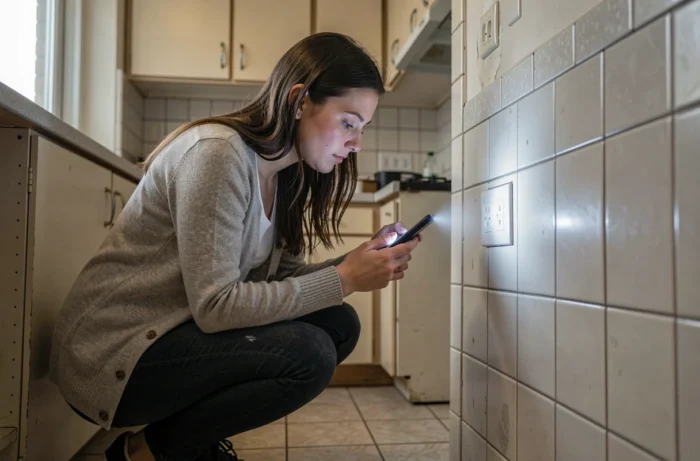
Linky meter and termination: why power is not always completely cut off
With the deployment of Linky meters, terminating an electricity contract no longer systematically leads to a total cut-off. The network manager reduces the power to a minimal level (often around 1 kVA) instead of physically cutting off the supply. This residual current is not enough to power high-consumption devices.
A Linky meter in reduced mode does not allow for testing electrical equipment. Plugging in an oven, a cooktop, or even a vacuum cleaner causes the meter to trip. Only a low-energy bulb might work, which remains insufficient for a complete inventory.
This situation creates a particular gray area. The outgoing tenant believes they have done what is necessary by terminating their contract. The landlord arrives on the day of the appointment and discovers that they cannot verify anything. The document signed under these conditions carries the seeds of a future dispute over the responsibility for unobserved damages.
Legal risks for the tenant and the landlord
The consequences differ depending on whether the cut is suffered or organized, and whether it is an entry or exit inventory.
For the outgoing tenant
- An incomplete exit inventory may lead the landlord to withhold part of the security deposit for damages they could not verify on the day of the inspection, which they later discover after the power is restored
- The tenant loses a means of proof: if the equipment was functioning correctly, the lack of testing prevents documentation
- In case of disagreement, resorting to a bailiff becomes necessary, with costs shared between the parties potentially reaching between 162 and 261 euros including tax depending on the area
For the landlord
Intentionally cutting off electricity to influence an inventory constitutes a criminal offense. Article 226-4-2 of the Penal Code, reinforced by the ELAN law, punishes the act of depriving an occupant of electricity, water, or gas. The penalty can reach 3 years of imprisonment and 30,000 euros in fines, even at the end of the lease.
This criminal risk is distinct from the classic rental dispute. A landlord who intentionally maintains the cut-off at the time of the inspection exposes themselves to prosecution independent of any questions regarding the security deposit or damages.
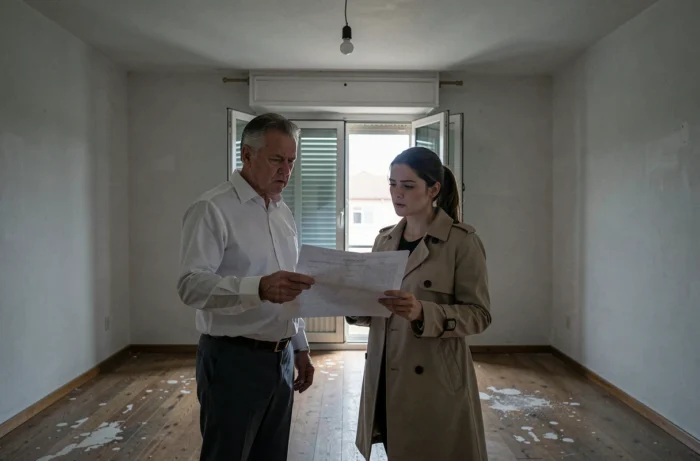
Postponement or partial inventory: which solution to prefer
Two options arise when power is lacking on the scheduled day.
The first is to postpone the inventory. The tenant or landlord subscribes to a temporary contract with an energy supplier to restore the supply. This process usually takes a few days with a Linky meter (the activation can be remote). Postponement remains the safest solution for both parties.
The second option is to establish a partial inventory. The document explicitly states that certain checks could not be performed due to the lack of electricity and includes a clause for a contradictory supplement after power restoration.
- The partial inventory must be signed by both parties with a clear mention of the unchecked points
- A standard clause may provide that the supplement will be carried out by a bailiff, with costs shared
- A signed inventory without reservation is considered definitive: revisiting it after signing requires a contradictory procedure
The choice between postponement and partial inventory depends on the schedule. If the tenant must return the keys by a specific date (end of notice, new tenant moving in), the partial inventory with a supplement clause represents an acceptable compromise. In all other cases, postponement with power restoration better protects both parties.
The obligation to deliver a decent housing, reiterated by the Court of Cassation in 2024, is continuous throughout the lease term. A landlord who hands over a property without functional electrical supply at the entry of a new tenant fails this obligation, regardless of the condition of the rest of the property.
Conducting an entry inventory without power amounts to accepting a property whose compliance cannot be verified. This gap weakens the tenant’s position from day one.