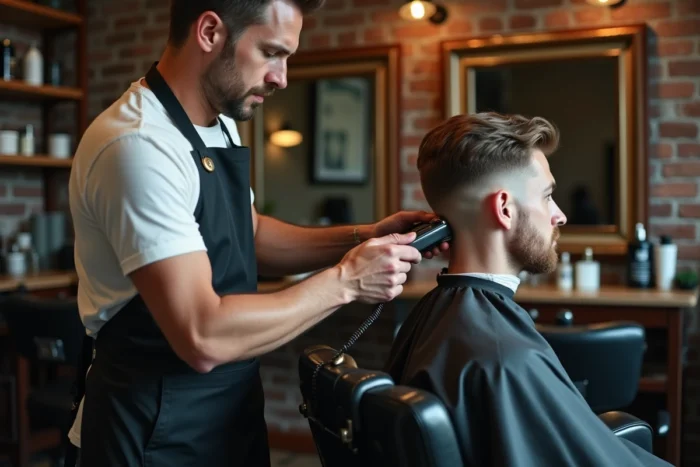
The low fade refers to a gradual transition in length that starts just above the ears and the nape of the neck, on the last two or three centimeters of hair. Unlike the mid fade or high fade, the shaved area remains discreet, and the contrast with the top of the head is smooth.
This cut suits the vast majority of face shapes and adapts well to both straight hair and curls or afro textures.
Low fade and beard connection: the continuity that changes everything
A point rarely addressed in general guides, yet crucial for the final result: the continuity of the fade between the temples and the beard. In a low fade, the cutting line stops very close to the area where the beard begins. Without a neat connection, a sharp visual break appears at the level of the low temple, disrupting the fading effect.
The technical principle is simple. The barber uses a shorter guard at the low temple, then gradually increases the length on the cheek. The goal is to extend the line of the fade into the top of the beard to achieve a uniform fade from the scalp to the chin.
This connection works particularly well with a structured beard (trimmed with clean lines). On a few days’ growth, the effect remains subtle yet clean. However, on a long and unshaped beard, the fade gets lost, and the low fade loses part of its graphic interest. If you wear a beard, be sure to specify this point to your barber: ask for a continuous fade from temples to beard, not two independent cuts.
To learn everything about the low fade for men and its technical variations, the topic deserves to be explored before heading to the salon.

Low fade according to face shape: adjusting height and volume
The low fade does not produce the same visual effect on a round, oval, or rectangular face. The approach based on facial proportions (what some barbers call facial anthropometry) allows for the adjustment of two variables: the exact height where the fade starts, and the volume retained on top.
- Round face: keep volume on top (pompadour, quiff) and keep the low fade very tight on the sides. The vertical contrast visually elongates the proportions.
- Long face: avoid too much height on top. A low fade with a short and textured cut on the scalp rebalances the silhouette without emphasizing the length of the face.
- Square or rectangular face: the low fade softens the angles of the jaw. Leaving a bit more length at the temples mitigates the angular effect.
- Oval face: the most versatile shape. Almost all variations of the low fade work, from a faded buzz cut to a style with long hair on top.
The starting height of the fade is played to the nearest centimeter. A low fade positioned too high on a round face loses its elongating effect. Too low on a long face, it rebalances nothing. It is precisely this micro-adjustment that distinguishes a successful cut from a generic result.
Scissor finishing: avoiding the clipper line
The clipper, even with progressive guards, sometimes leaves a visible line of demarcation in the last centimeters of the fade. Barbers specialized in fades emphasize a specific technical point: the final fade must end with scissors.
Specifically, after using the clipper with decreasing guards, the barber takes the high transition area (where the fade meets the length on top) with sculpting scissors. This step removes the “step” that the clipper alone can leave, especially on thick or wavy hair.
If you are doing your fade yourself, this is often the step that is missing. The clipper creates the bulk of the fade, but the scissor finishing ensures fluidity. Without it, the transition between the short area and the long area remains noticeable, even from a distance.
Low fade on afro and curly hair: technique and maintenance
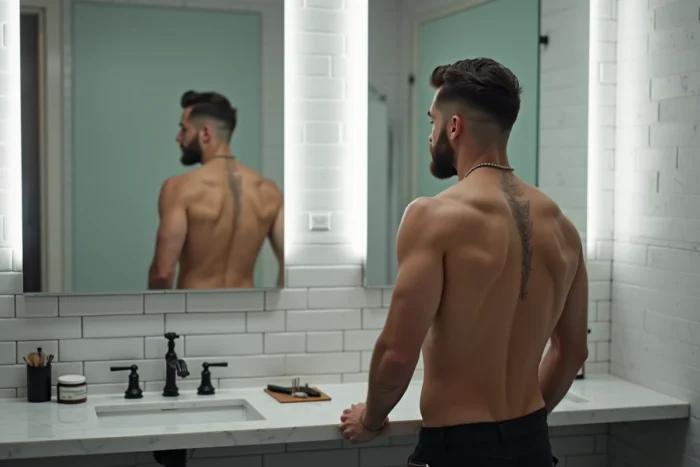
The afro low fade (low fade on curly or very curly hair) is gaining increasing popularity, and for a concrete technical reason: it highlights the natural texture of the hair on top while keeping the sides clean. The contrast between the natural volume of the curls and the faded area creates a sculptural effect that other fade heights do not produce with the same intensity.
On this type of hair, the fade requires more passes with the clipper and a finer progression between the guards. The density of curly hair makes every millimeter of difference more visible. A barber experienced with afro textures will adjust their guards accordingly.
Maintenance also differs. A low fade on afro hair loses its sharpness faster than a high fade, because regrowth in the lower area is immediately visible on dense hair. Planning a visit to the salon every two to three weeks helps keep the fade clean. Between visits, regular brushing and appropriate hydration (shea butter, jojoba oil) maintain the definition of curls on top.
Requesting your low fade in the salon: the three pieces of information to provide
The majority of failed cuts come from a misunderstanding between the client and the barber. Three pieces of information are enough to achieve the desired result:
- The height of the fade: “low fade” means that the transition starts above the ear, not in the middle of the scalp. Showing a reference photo removes any ambiguity.
- The intensity: a “skin fade” goes down to the skin, while a “classic fade” retains a few millimeters at the shortest point. Specify what you want.
- The beard connection: if you wear a beard, indicate whether you want a continuous fade or a clear separation between the cut and the beard.
Bringing a photo remains the most reliable method. The terms “low fade,” “taper,” or “dégradé bas” do not mean exactly the same thing across salons. A reference image eliminates most misunderstandings.
The low fade remains one of the most versatile cuts in the male repertoire. Its discretion makes it compatible with a strict professional setting, and its adaptability (length on top, beard connection, texture) gives it a stylistic lifespan that few other cuts achieve.