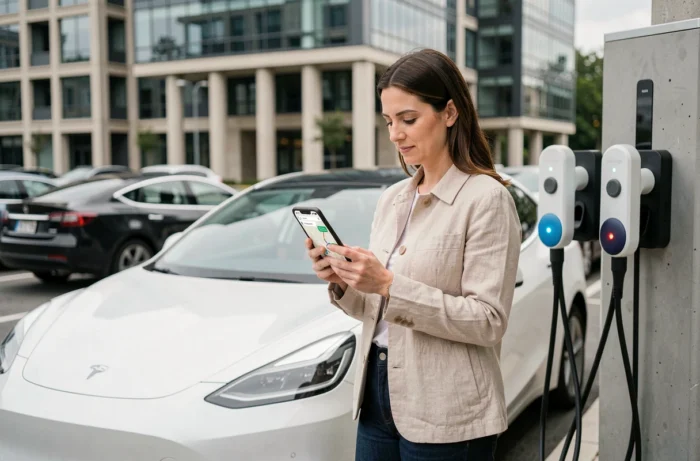
Planning a journey in an electric car relies on three measurable variables: the vehicle’s real range, the power of the charging stations available along the route, and the payment method accepted at each charging point. Since the implementation of the European AFIR regulation in April 2024, these parameters are evolving rapidly, and the differences between newer and older charging stations create very different situations for the same itinerary.
Charging Stations: Comparison of Obligations Based on Installation Date
The AFIR regulation distinguishes two categories of fast charging stations based on their commissioning date. This distinction significantly changes the charging experience on a long trip.
| Criterion | Fast charging station installed after April 13, 2024 | Fast charging station installed before April 13, 2024 |
|---|---|---|
| Minimum power concerned | 50 kW and above | 50 kW and above (TEN-T network) |
| Contactless card payment | Mandatory from installation | Mandatory by January 1, 2027 |
| Billing per kWh (without contract) | Mandatory | Not guaranteed before 2027 |
| Badge or app required | Not mandatory for charging | Often necessary until 2027 |
On major European routes, payment by credit card without a badge is becoming the norm for any recent station of 50 kW or more. For older stations located along the trans-European road network, this obligation will apply from January 1, 2027.
In practice, a driver using a highway equipped with recent charging stations no longer needs to download multiple apps or possess different badges. However, on secondary routes or older stations, the badge often remains the only way to start a session.
Before leaving, it is still useful to calculate an electric car route with 1 Monde to precisely identify which stations are on the route and anticipate their payment methods.
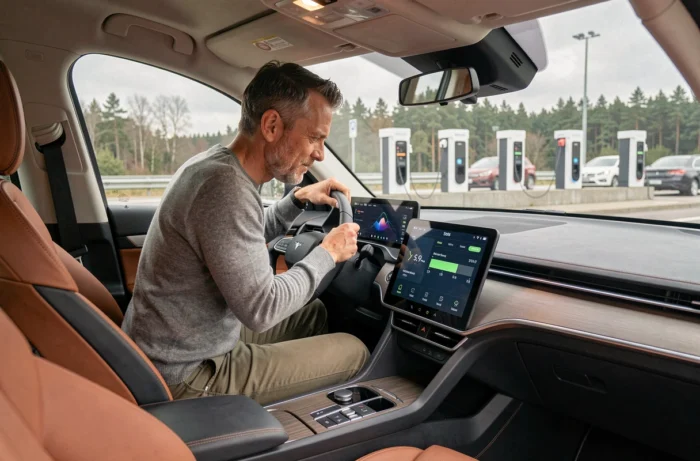
Real Range on the Highway: Discrepancies That Change Planning
The range announced by manufacturers follows the WLTP cycle, measured under mixed conditions. On the highway, at a stabilized speed between 120 and 130 km/h, the actual consumption significantly increases compared to this standard.
The loss of range observed on the highway varies by model, but it commonly reaches 20 to 40% compared to the WLTP value. A vehicle rated at 400 km WLTP range can drop below 280 km in real highway conditions, especially in cold weather or with the air conditioning running.
This discrepancy requires recalculating stops based on effective range rather than catalog value. Three factors exacerbate consumption:
- Speed: each increment of 10 km/h above 110 km/h increases consumption non-linearly, as aerodynamic drag increases with the square of speed
- Outside temperature: heating the cabin in winter and thermal conditioning of the battery heavily draw on the onboard energy
- Vehicle load: a full trunk and several passengers add weight, which directly translates into kilowatt-hours consumed per kilometer
A reliable route planner incorporates these parameters to propose charging stops tailored to the actual profile of the trip, not a theoretical value.
Charging Stop Strategy: Why Aiming for 80% Changes Everything
The charging curve of a lithium-ion battery is not linear. The charging power drops significantly beyond 80% capacity. Specifically, going from 10 to 80% on a fast charger can take about twenty minutes on some recent models, while the remaining 20% can sometimes take just as long.
This technical characteristic has a direct consequence on planning: multiplying short stops (charging from 20 to 80%) is faster than making a single long stop aiming for 100%. The total charging time on a journey of several hundred kilometers can vary from simple to double depending on the strategy adopted.
Anticipating Queues at Fast Charging Stations
During peak travel times, the influx at fast charging stations creates queues that add to the actual charging time.
To limit this risk, two levers work:
- Stagger charging stops away from the busiest areas, favoring stations located slightly off the highways
- Leave with a battery charged to 100% to postpone the first stop and avoid congestion areas near large urban centers
- Use a planner that shows real-time availability of stations, such as Chargemap or the onboard systems of manufacturers
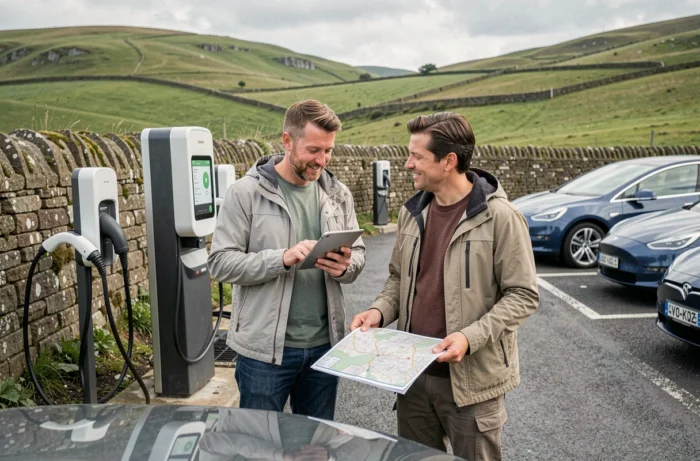
Payment and Interoperability of Charging Networks in 2026
The landscape of charging operators remains fragmented. Each network (Ionity, TotalEnergies, Fastned, Allego, local networks) offers its own identification and billing system. Roaming apps attempt to unify access, but prices vary significantly depending on whether you pay directly or through an intermediary.
Billing per kWh, made mandatory at recent fast charging stations for users without a contract, brings new transparency. Before this rule, some operators billed by the minute or flat rate, making cost comparison between two stations nearly impossible.
France has surpassed 200,000 public charging points, but the geographical distribution remains uneven. Rural areas and certain secondary routes are still under-equipped, reinforcing the need to check coverage before committing to an unusual itinerary.
The AFIR regulation accelerates standardization. By 2027, an electric vehicle driver crossing France on the highway network will theoretically be able to charge everywhere with their credit card, without an app or badge. This deadline remains to be confirmed in practice, as the compliance of existing stations depends on the pace of payment terminal replacements by each operator.