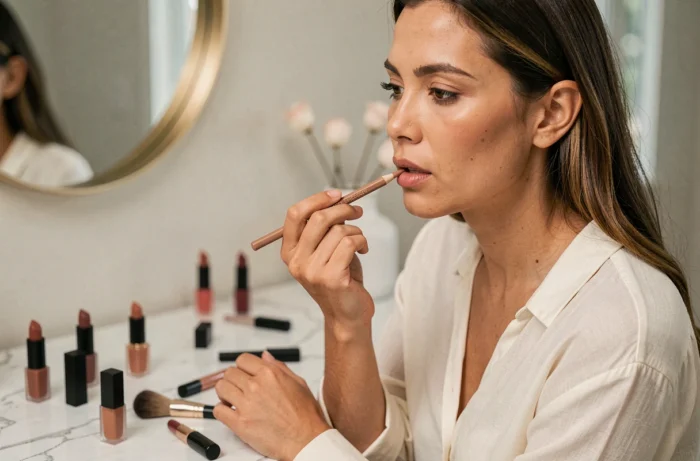
We’ve all experienced that moment when lipstick bleeds after an hour of wear, settles into fine lines, or loses its shape after the first coffee. Lip liner solves many of these problems, but its use has changed. The question is no longer whether to pair it with lipstick, but rather how to use it to achieve a result that lasts and looks natural.
Lip liner and velvety matte lipstick: the game-changing duo in 2026
Velvety matte lipsticks dominate the fall collections. Their texture provides good coverage, doesn’t stick, but presents a concrete problem: without preparation, the demarcation between the color and the skin is visible. The outline stands out, especially on dark shades or deep reds.
This is where the lip liner comes in, but not in the way we used to use it. We no longer draw a sharp line around the lips. We apply the liner on the outline, then gently blend it inward with a brush or our finger. The matte lipstick is then applied on top, and the transition between the color and the skin disappears.
A creamy liner, close to the natural lip shade or a half-tone darker than the chosen lipstick, works better than a dry liner for this purpose. Too hard tips create a visible line that the matte finish does not conceal. To wear lipstick with liner consistently, we look for a product that blends easily without resistance.
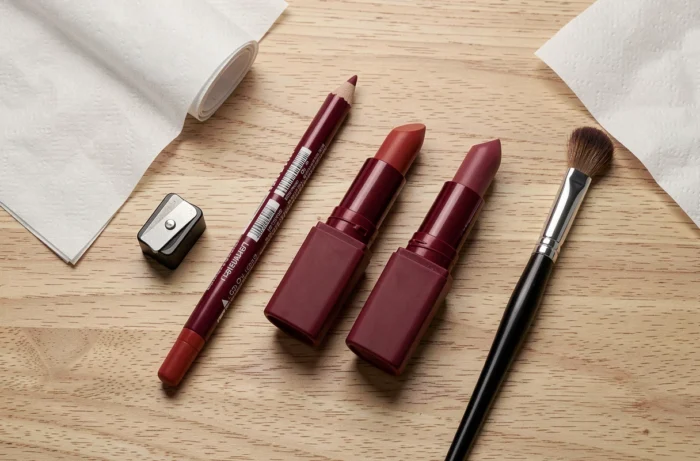
Blurred overlining: the liner as an optical volume tool
The blurred lips trend has transformed the role of the liner. We no longer draw a strict outline to “enlarge” the mouth. We create a slight blur around the natural outline that gives the illusion of volume without an artificial effect.
Specifically, we go just over the edge of the lips by one millimeter, no more. We blend this line outward with a cotton swab or a clean lip brush. The lipstick or gloss applied afterward captures the light in this blurred area, visually pushing back the boundary of the mouth.
What makes the difference between successful and unsuccessful overlining
The choice of liner shade. A liner that is too dark compared to the lipstick creates a visible ring around the mouth, especially in natural light. A liner that is too light produces no effect. The right reflex: choose a liner that is exactly the same tone as the lipstick, or a half-tone above.
Texture also matters. A liner with a hint of shine or a satin formula blends better than an ultra-matte liner for this specific use. Feedback on this point varies by brand, but the principle remains the same: the easier the liner is to work with, the more natural the blur appears.
When lip liner replaces lipstick
We don’t talk about it enough, but the liner can be used alone. Some shades of liner provide enough coverage for everyday makeup, especially when looking for a discreet matte look without layering multiple products.
- We color the entire lip with the liner, not just the outline, then tap with our finger to even out the color
- We add a touch of clear balm on top to avoid a dried-out effect, without compromising wear
- We choose a liner with a sufficiently soft tip so it doesn’t pull on the skin, especially if the lips are dry
The liner alone often lasts longer than a classic lipstick because its waxier formula adheres better to the skin. For a lunch or meeting where we don’t want to touch up, it’s a working option.
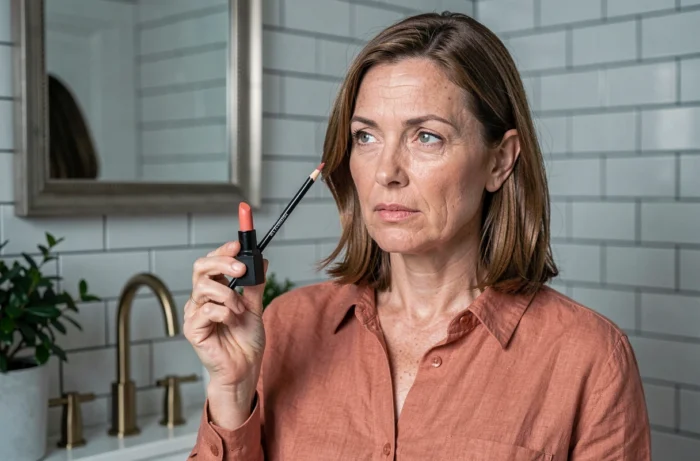
Pairing liner and gloss: color mistakes to avoid
Gloss regularly returns in current looks, often applied over a liner to combine wear and shine. A common pitfall: a dark liner under a light gloss creates a dirty effect that ages the mouth instead of enhancing it.
The most reliable rule remains to keep the liner in the same color family as the gloss. A rosy liner under a pink gloss, a nude liner under a peach gloss. Strong contrasts (like a burgundy liner under clear gloss, for example) require very careful blending to avoid showing the outline line.
Three liner and color combinations that work daily
- Rosy nude liner plus medium pink lipstick: the all-purpose duo that structures without overwhelming
- Rosewood liner plus raspberry matte lipstick: a slight contrast that adds depth without the “outlined lips” effect
- Clear (or “universal”) liner plus any gloss: the solution when we don’t want to multiply products in our bag
So-called universal liners, in neutral shades close to the natural lip tone, simplify the choice. They can be paired with any lipstick or gloss color without risk of mismatch.
Pairing a liner with lipstick is not mandatory, but it’s the gesture that separates a makeup look that lasts two hours from one that lasts all day. The liner is no longer just for containing the color. It shapes volume, smooths transitions, and can even replace lipstick when we want to be quick. The only real pitfall is a poor color match, and now we know how to avoid it.