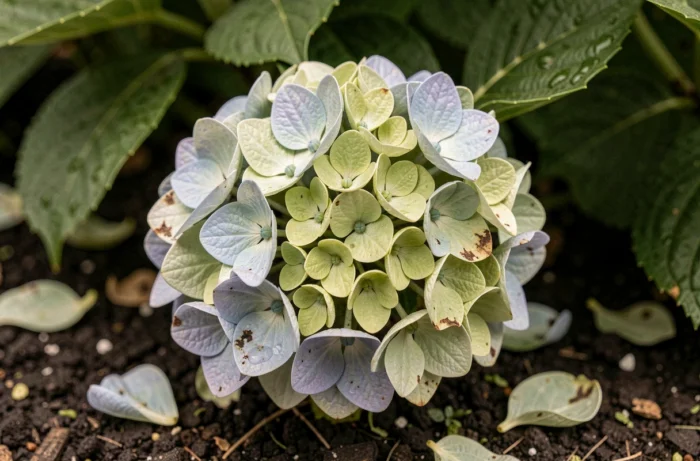
You planted a hydrangea with bright blue or pink flowers, and a few weeks later, the inflorescences turned green. This phenomenon is common, but its causes vary greatly from case to case. Understanding what is happening in the plant helps to distinguish normal greening from a real warning sign, and especially to act at the right time.
The role of sepals in the color of hydrangeas
What we call “flowers” in hydrangeas are not petals in the classical sense. They are sepals, modified floral parts that surround the tiny fertile flowers at the center of the inflorescence. This distinction changes everything for understanding the greening.
The sepals contain pigments (anthocyanins) that give them their blue, pink, or purple hues. At the same time, they also contain chlorophyll, the same green pigment found in leaves. At the beginning of flowering, the anthocyanins dominate and mask the green. As the sepals age, the production of anthocyanins slows down, and the chlorophyll becomes visible again.
The phenomenon of hydrangea flowers turning green at the end of summer is often a natural cycle, not a disease. If your inflorescences gradually turn green after several weeks of blooming, there is nothing to correct.
On the other hand, when green appears at the beginning of flowering or when the colors never really settle, other factors come into play.
Double thermal and water stress: when watering is not enough
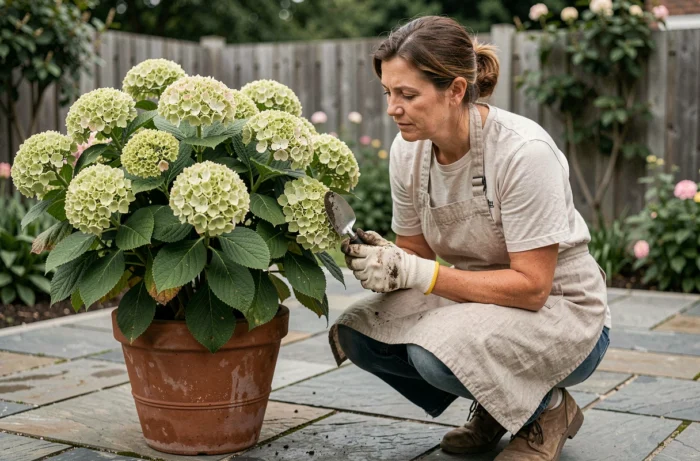
You water regularly, but the flowers remain dull or greenish? The heat of the soil exacerbates stress just as much as lack of water. During heatwaves, the surface of the substrate can heat up significantly, especially in pots or on compact soil. The water applied to the surface evaporates before reaching the roots.
This double stress, thermal and hydric, prevents the plant from properly producing its pigments. The sepals remain green or take on a washed-out, dull pink hue that does not match the expected color.
Slow and deep watering rather than frequent and light
The solution is not to water more often, but to water differently. Favor slow and deep watering that allows water to reach the roots. A hose placed at the base of the plant for about ten minutes with a low flow works better than three watering cans poured quickly.
- Mulch the base with a good thickness to limit evaporation and maintain soil freshness
- Water early in the morning or in the evening, never in full sun when the soil is scorching
- For potted hydrangeas, ensure that drainage works well: an overheated pot with stagnant water at the bottom literally cooks the roots
If your hydrangea is in the ground and exposed to direct sunlight in the afternoon, consider creating partial shade for it with a veil or a neighboring shrub. Exposure matters as much as watering in maintaining colors.
Soil pH and aluminum: the chemistry that colors your hydrangeas
You may have noticed that some hydrangeas change from blue to pink, or vice versa, depending on where they are planted. For Hydrangea macrophylla and H. serrata, the color directly depends on the plant’s ability to absorb aluminum present in the soil.
An acidic soil releases aluminum, which produces blue. A neutral or calcareous soil blocks aluminum, and the flowers remain pink. When the pH is in an intermediate range, the plant only absorbs part of the available aluminum. The pigments form poorly, and the sepals may remain greenish or take on indecisive hues.
Testing and adjusting the pH of your soil
A pH test kit, available at garden centers, provides a quick reading. To achieve blue, the soil must be decidedly acidic. For pink, a neutral to slightly calcareous soil is sufficient.
- To acidify: add heather soil or aluminum sulfate at the base of the plant
- To maintain a bright pink: add a little lime or wood ash
- Avoid very calcareous tap water for watering if you want to keep blue flowers, as it gradually raises the pH
This pH adjustment only works on varieties sensitive to aluminum. White hydrangeas, for example, will not change color regardless of the pH. And Hydrangea paniculata or quercifolia do not react the same way as macrophylla.
Fertilizers and chlorosis: two often confused issues
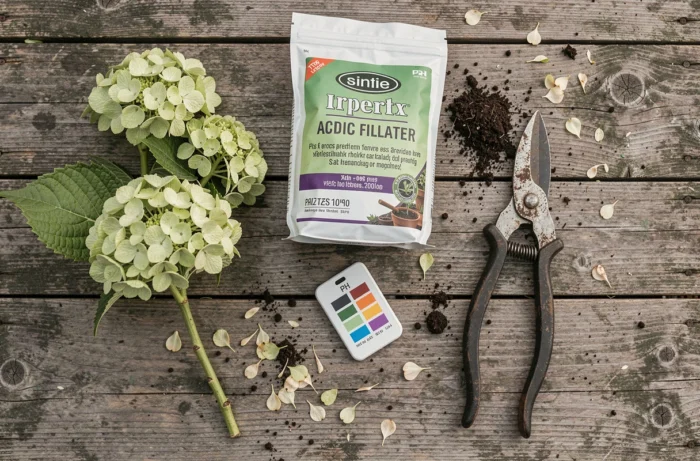
A hydrangea whose flowers are turning green and whose leaves are yellowing at the same time may have iron chlorosis. This problem occurs when the plant cannot absorb iron from the soil, often because the pH is too high. The leaves yellow between the veins, which remain green. The flowers lose their luster.
Chlorosis is treated with an application of chelated iron, available at garden centers. An acidic soil amendment resolves the issue in the long term.
An excess of nitrogen fertilizer can also green the flowers
A fertilizer too rich in nitrogen stimulates the growth of leaves and stems at the expense of flowering. The plant invests in green (chlorophyll, foliage) rather than in floral pigments. If you fertilize regularly, check the composition of your fertilizer. A fertilizer for flowering plants, rich in potash, promotes the coloration of the inflorescences.
Reduce nitrogen inputs from the moment the flower buds appear. Nitrogen remains useful in spring to kickstart growth, but it becomes counterproductive once flowering begins.
The greening of hydrangeas does not call for a single response. A turn to green at the end of the season is a natural cycle that requires no intervention. Early greening, associated with dull or yellowing leaves, indicates a problem with soil, watering, or fertilization. The diagnosis is made by cross-referencing several indicators: leaf color, timing of the green appearance, soil type, and exposure. It is this combined reading that allows for precise action.