The autumn-winter 2026-2027 season is not just about a parade of new silhouettes. It opens up in a regulatory context that directly modifies what brands can produce and promote in France. Law No. 2026-602 of July 8, 2026, the first French legislation specifically targeting ultra-fast fashion, has imposed environmental penalties of up to 12 euros per item for articles deemed ultra-fast fashion since September 1, 2026.
This framework reshapes the fashion trends of the season well beyond the runways.
Anti-fast fashion law and consequences on autumn-winter fashion trends
The text introduces a legal definition of ultra-fast fashion and applies a penalty regime modulated according to the volume of references put on the market. Platforms like Shein or Temu, which refresh their catalogs at an accelerated pace, are the primary targets.
The legal cap for the penalty is set at 50% of the price excluding tax. For a coat or jacket, this cap must rise to 19.50 euros by 2030. The direct result: low-cost brands will have to reduce the number of new items, improve the durability of pieces, or pass on the additional costs to their prices.
For consumers, this means fewer disposable micro-trends and a refocusing on clothing designed to last several seasons. Sturdy materials (leather, thick velvet, structured wool) are gaining ground against lightweight synthetic fabrics. The available online and in-store offerings already reflect this shift: among the savage culture collection on Wow Magazine, we see pieces with bold cuts designed to last through winter without going out of style in the following spring.

Materials and colors that structure the seasonal wardrobe
The autumn-winter 2026-2027 runways confirm a clear orientation towards tactile and visible materials. Velvet returns on jackets and dresses, while leather extends beyond jackets to adorn skirts, trousers, and even everyday accessories.
Velvet and leather as central pieces
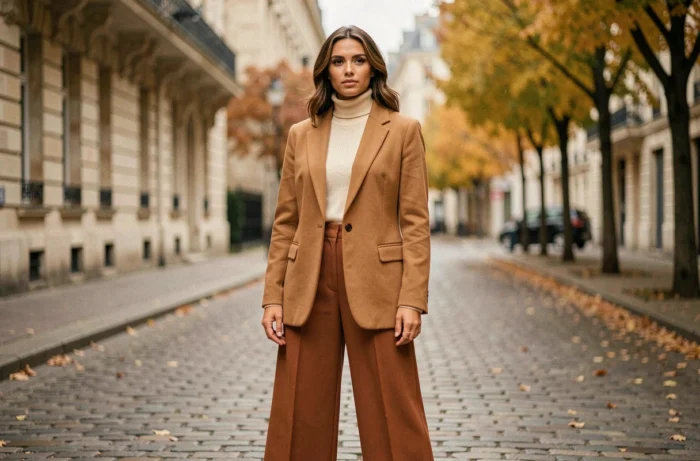
Velvet is no longer confined to evening wear. It can be found on daytime coats, paired with straight cuts that avoid the suit effect. Leather, on the other hand, comes in earthy or burgundy tones that replace the systematic black of previous seasons.
Natural colors dominate the autumn palette: brown, khaki, rust, cream. Saturated tones (bright red, cobalt blue) appear as accents on an accessory or a unique piece rather than in a total look. This approach aligns with the sustainability logic promoted by the new regulatory framework, as neutral colors allow for combining pieces across several seasons.
Denim as a common thread
Denim remains the backbone of the wardrobe. Wide, high-waisted cuts, established for several seasons, show no signs of weakening. However, the finishes are changing: raw washes, unhemmed edges, heavier fabrics. A well-cut pair of jeans in a thick fabric replaces three low-quality jeans, which aligns with the anti-waste message promoted by the law.
Key silhouettes: structured jacket, long dress, and midi skirt
Three pieces are capturing the attention of designers this season. They share a common point: their versatility.
- The structured jacket, often with pronounced shoulders, can be worn over raw denim or with a flowing dress. Versions in boucle wool or heavy tweed are the most visible on the runways.
- The long dress in knit or velvet works as a standalone piece or as an intermediate layer under a loose coat. It replaces the top-skirt combo in mid-season looks.
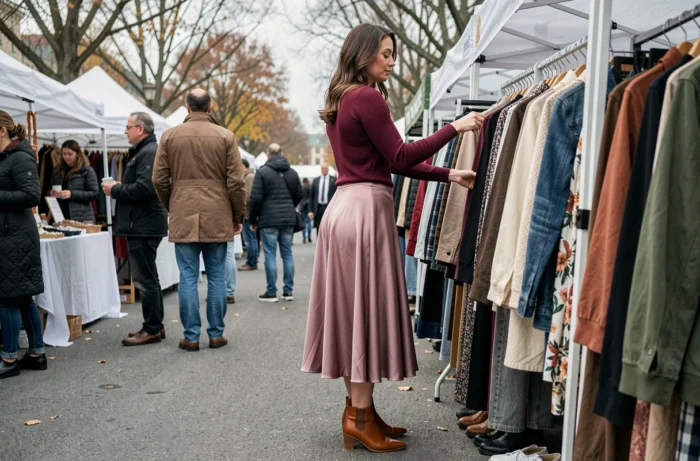
- The midi skirt, cut below the knee, returns in heavy materials (leather, felted wool) that give it structure without lining. It is worn with tall boots, extending the vertical line of the silhouette.
These three pieces illustrate the shift towards a more streamlined wardrobe. Rather than accumulating single-use clothing, the logic is to invest in quality basics that last the entire season.
Autumn-winter fashion accessories: minimalism gains ground
On the accessories side, the trend is towards simplicity. Bags are losing size and embellishments. Jewelry is becoming discreet: fine chains, simple earrings, cuff bracelets in brushed metal.
The standout accessory of the season remains the statement coat, worn as a signature piece that is enough to define a silhouette. Long, oversized, in a bold color or textured material, it plays the role that branded bags once held: asserting a style without multiplying pieces.
Shoes are following the same direction. Low or flat heeled boots dominate, in smooth leather or suede. Comfort is no longer a compromise but a full-fledged style criterion, reflecting a change in buyer expectations.
Sustainability and fashion trends: a now regulatory link
The novelty of this season lies not so much in the shapes or colors but in the framework within which they emerge. With Law No. 2026-602, the durability of a garment becomes a legal cost factor for brands. Brands that relied on constant renewal must rethink their model.
Field reports diverge on this point: some brands absorb the penalty without modifying their offerings, while others drastically reduce the number of references. The available data does not yet allow for measuring the actual impact on in-store prices. What is visible is a brand discourse that incorporates longevity as a selling point, where previously only novelty was discussed.
The autumn-winter 2026-2027 wardrobe is thus being built at the intersection of two forces: the aesthetic proposals of designers and a legal framework that penalizes disposability. For consumers, the concrete result is a refocusing on durable pieces, solid materials, and cuts that do not depend on a fleeting micro-trend.