
We buy a non-buildable plot of land to set up a vegetable garden, store equipment, enjoy a leisure space, or supplement an agricultural parcel. The price per square meter is low, sometimes ridiculously so compared to a building plot. And yet, notary fees represent a much higher percentage than one might imagine, especially on small transactions. Understanding their mechanics avoids unpleasant surprises at the time of signing the authentic deed.
Why notary fees weigh more heavily on a low-priced plot
On a non-buildable plot sold for a few thousand euros, one expects proportional notary fees. The reality is different. The notary’s fees follow a regulated decreasing scale: the rate applied on the first bracket (up to 6,500 euros) is 3.87%, then drops to 1.59% on the next bracket, and continues to decrease beyond that.
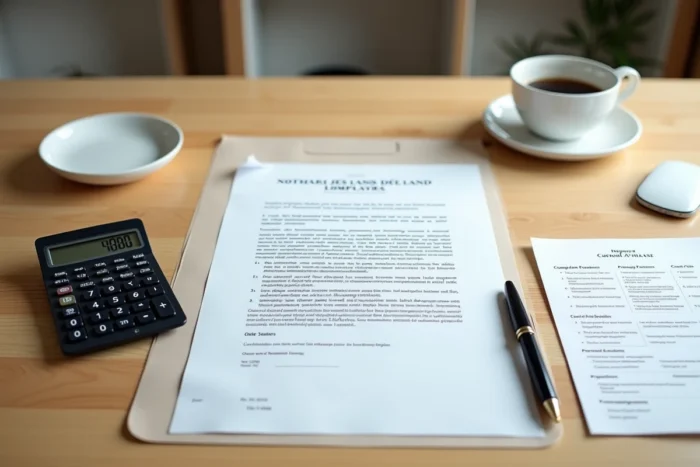
On a plot sold for 3,000 euros, the fees alone are already approaching a hundred euros. Add the transfer duties, disbursements, and real estate security contribution, and the total can represent a quarter or more of the purchase price. To better anticipate the notary fees for a non-buildable plot, it is beneficial to break down each item before signing the compromise.
This decreasing mechanism penalizes modest purchases. On a plot priced at 40,000 euros, the overall percentage hovers around 7 to 8%. On a plot priced at 5,000 euros, it can climb well beyond 10% proportionally. This is a point that online calculators do not emphasize enough.

Transfer duties and departmental rate: the local variable
Transfer duties (also known as registration fees) constitute the heaviest part of acquisition costs. They are paid to the State and local authorities. The departmental rate varies from one territory to another, which significantly alters the final total for the same sale price.
Contents that announce “7 to 8% notary fees” provide a national average. In practice, buying a non-buildable plot in a department that applies a higher rate will cost more than an identical purchase in a neighboring department with a standard rate. Before making an offer, one can ask the notary for the exact rate applicable in the relevant municipality.
Land advertising tax and real estate security contribution
In addition to registration fees, the sale incurs a land advertising tax and a real estate security contribution. The latter compensates the land advertising service that registers the transfer of ownership. Its amount is modest, but it adds to the total and appears on the notary’s statement.
Agricultural, natural, or leisure land: distinct tax situations
A plot classified as “non-buildable” in the Local Urban Plan can cover very different realities. A meadow in an agricultural zone, a wooded parcel in a natural zone, and a leisure plot by a river do not imply the same tax treatment or the same notarial verifications.
- An exploited agricultural plot may qualify for specific exemptions or reductions depending on the buyer’s status and the intended use, especially if a rural lease is in place.
- A natural plot subject to environmental easements (flood zone, protection perimeter) incurs additional disbursements for urban planning documents and risk assessments.
- A leisure plot without utilities does not benefit from any special regime: transfer duties apply at the full rate, just like for an old buildable plot.
Feedback varies on this point, as some hybrid situations (agricultural land resold to an individual for recreational use) create a gray area that only the notary can resolve on a case-by-case basis.
Notary fees: understanding the decreasing scale
The fees are not negotiable in the strict sense. They follow a scale set by decree, organized into four brackets. However, the notary can grant a discount on their remuneration under certain conditions, usually on transactions where the price exceeds 100,000 euros. For a non-buildable plot sold well below this threshold, this possibility remains theoretical.
The “disbursements” item also deserves attention. It covers the costs that the notary advances to obtain the necessary documents for the sale:
- Cadastral extracts and urban planning documents from the town hall.
- Mortgage status to verify the absence of charges on the land.
- Any diagnostics or certificates related to the location (natural risks, soil pollution).
On a low-value non-buildable plot, disbursements can represent a disproportionate part of the total. The notary must provide a detailed forecast statement before signing.
Sale by a professional subject to VAT: a special case
When the seller is a professional subject to VAT (a developer, an agricultural operator under real regime), the transaction may shift to a reduced fee regime. The transfer duties then apply at a rate significantly lower than the classic regime, as VAT is applied to the sale price.
This case remains rare for non-buildable plots, which are mostly sold between individuals. Checking the seller’s tax status before signing the compromise allows one to anticipate the applicable regime and avoid a discrepancy of several hundred euros on the final statement.
Who pays the notary fees
By convention and by usage, it is the buyer who pays the entirety of the notary fees at the time of signing the authentic deed. Nothing prevents the parties from negotiating a split in the compromise, but this practice remains marginal for non-buildable plots where the amounts at stake are modest.
The amount of notary fees on a non-buildable plot depends less on whether the plot is buildable or not than on the sale price, the department, and the seller’s status. On small transactions, the decreasing structure of the scale and the weight of fixed disbursements make these fees proportionally higher. Requesting a forecast statement from the notary as soon as the compromise is made remains the best way to budget the operation without approximation.