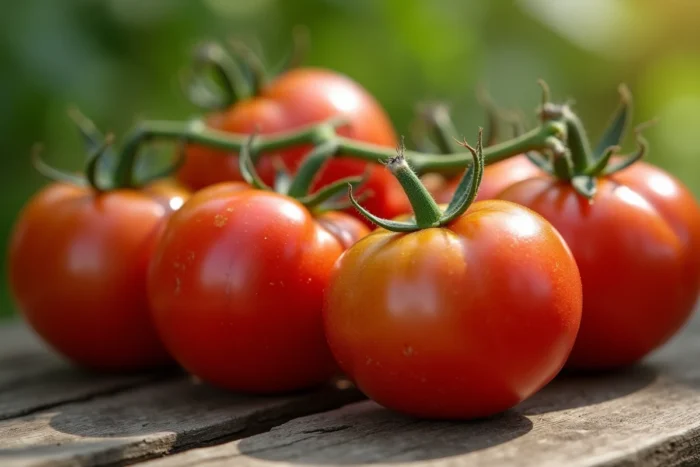
We pick a ripe red tomato, take a bite, and the skin feels like plastic. Even though the fruit is ripe, the texture ruins everything. This problem arises every summer in gardens, and heat is not the only culprit. Understanding what thickens the cuticle allows us to act on the right levers, from variety selection to water management.
Thermal stress and cuticle: what heat does to your tomatoes’ skin
When we observe tomatoes with tough skin in the middle of July, the reflex is to blame the sun. The mechanism is more precise than that. Under prolonged thermal stress, the fruit thickens its cuticle to limit water loss. This waxy layer, which protects the tomato from dehydration, becomes significantly denser when temperatures exceed 30 °C for several days.
Research from the USDA and North Carolina State University confirms this reaction: the plant adapts the composition of the fruit’s skin in response to heat. The result in the mouth is a hard skin, sometimes almost rubbery, even when the flesh is perfectly ripe.
We better understand why tomato skins are tough by looking at the actual growing conditions rather than blaming a single cause. The cuticle does not thicken overnight: it is a cumulative stress, day after day, that causes the hardening.
In practice, a tomato plant grown in full sun without any protection during a heatwave produces fruits with significantly tougher skin than an identical plant under a light shading cloth.
Irregular watering and tough tomato skin: the real summer trap
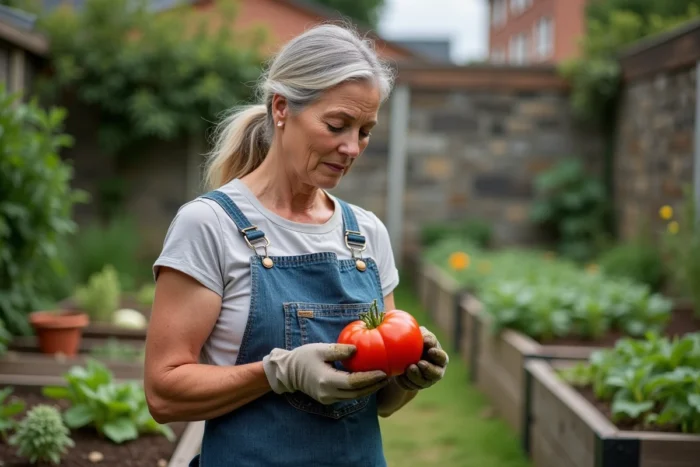
The most common mistake is not overwatering or underwatering. It is irregularity. Soil that goes from dry to waterlogged in a few hours causes a sudden swelling of the flesh. The skin, which had hardened during the dry period, does not keep up with the expansion and cracks, or remains thick and hard if the fruit does not burst.
Regular and moderate watering better protects the texture than heavy watering after a drought. The goal is to maintain consistent moisture at the base, without fluctuations. Mulching plays a direct role here: it cushions moisture variations in the soil and limits evaporation between waterings.
How to stabilize moisture at the base
- Apply a generous layer of mulch (straw, dried grass clippings, wood chips) to keep the soil cool even in the heat. Renew it as soon as the thickness decreases.
- Water in the morning rather than in the evening, at the base and never on the foliage, so the soil absorbs the water before temperatures rise.
- Prefer drip irrigation or slow watering that allows water to penetrate deeply, rather than a quick spray that runs off the surface.
Feedback varies on the ideal frequency, as it all depends on the type of soil and exposure. In clay soil, we space out watering more. In sandy soil, we water more often but in smaller amounts.
Tomato varieties with thin skin: variety choice makes all the difference
We can optimize watering, mulch, shade, and still harvest tomatoes with thick skin. The reason is genetic. Variety studies conducted by Texas A&M and the University of Florida show a clear correlation between heat-resistant varieties and thicker cuticles. Lines selected for long-distance transport or crack tolerance inherently have tougher skin.
Heirloom varieties (Brandywine, Pineapple, Black Crimea) generally have much thinner skin than commercial F1 hybrids. The trade-off: they are more fragile, crack more easily, and do not store as long after harvest.
Tomatoes with tender skin: some concrete guidelines
If skin tenderness is a priority, we lean towards meaty, indeterminate growth varieties. Cornue des Andes and Green Zebra are often mentioned in gardening forums as exceptions with thin skin. Cherry tomatoes, on the other hand, almost always have proportionally thicker skin relative to their size.
Choosing the variety before planting avoids compensating for a genetic defect with ineffective cultural adjustments. A hybrid designed for mass distribution will never yield skin as supple as an heirloom variety, even under optimal growing conditions.
Harvesting at the right stage and finishing ripening in the shade
We often let tomatoes ripen as long as possible on the vine, thinking that the flavor improves. In periods of intense heat, this habit exacerbates skin hardening. The fruit continues to produce cuticle to protect itself from direct sunlight.
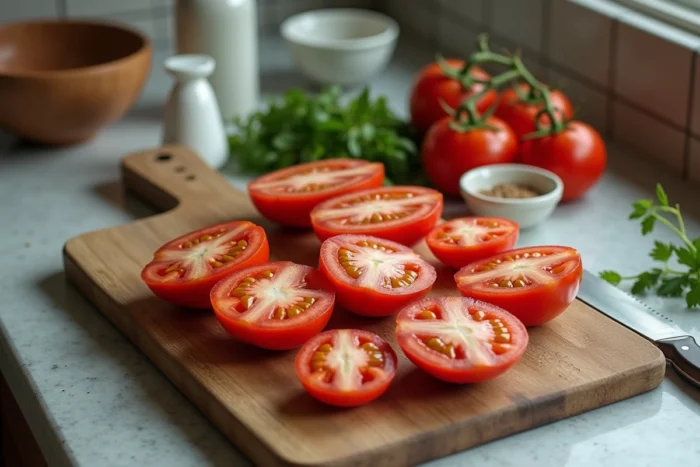
Tests reported by IRIIS Phytoprotection show that harvesting at the first blush and then letting them ripen indoors results in a more tender skin, for the same variety. The fruit completes its ripening without overheating, and its cuticle does not thicken further.
In practice, we pick the tomato as soon as it starts to turn from green to pink-orange. We place it in a temperate spot (kitchen, cellar), out of direct sunlight. In a few days, it reaches full ripeness with soft flesh and a significantly less resistant skin under the bite.
Protecting fruits still on the vine
- Install shading cloth during the hottest hours (between noon and 4 PM) to reduce the temperature around the fruits.
- Avoid excessive leaf removal: the foliage naturally protects the tomatoes from direct radiation.
- Keep suckers during heat waves, contrary to the usual reflex of removing them, as they help shade the fruits.
The tough skin of tomatoes is not an inevitability linked to amateur gardening. It is the combination of water stress, prolonged exposure to heat, and inappropriate variety selection that produces this result. Acting on these three levers simultaneously makes a visible difference from the very first adjusted harvest.