
The Armor Lux sticker operation at Intermarché, scheduled from May 12 to August 2, 2026, is based on a promotional mechanism that seems simple on the surface. Collect stickers with each checkout, complete a booklet, and redeem a branded product at a reduced price. However, behind this established scheme, several gray areas remain, particularly for customers who order online or juggle between multiple shopping channels.
Armor Lux stickers in-store and online: a comparison of access conditions
The central question for omnichannel customers concerns the parity of treatment between physical checkout and online orders. Both channels allow for sticker accumulation, but the practical conditions differ significantly.
| Criteria | In-store purchase | Online purchase |
|---|---|---|
| Required loyalty card | Yes, mandatory | Yes, mandatory |
| Sticker allocation | Automatic at checkout | Credited to the loyalty account after pickup |
| Choice of Armor Lux item | Immediate pickup in-store (subject to stock) | In-store pickup only |
| Visibility of available stock | On-site | Not guaranteed online |
| Accumulation of stickers between channels | Yes, on the same card | Yes, on the same card |
The point that deserves attention: stickers from online and in-store purchases accumulate on the same loyalty card. A customer who alternates between the two shopping modes does not lose anything, provided their card is properly linked to each transaction.
On the other hand, the pickup of the Armor Lux item remains exclusively physical. Even a 100% online customer must go to the store to retrieve their product, with no guarantee that the desired item will still be in stock at that time.
A detailed article on the Armor Lux and Intermarché collaboration 2026 highlights several of these asymmetries between channels that the official communication does not clarify.
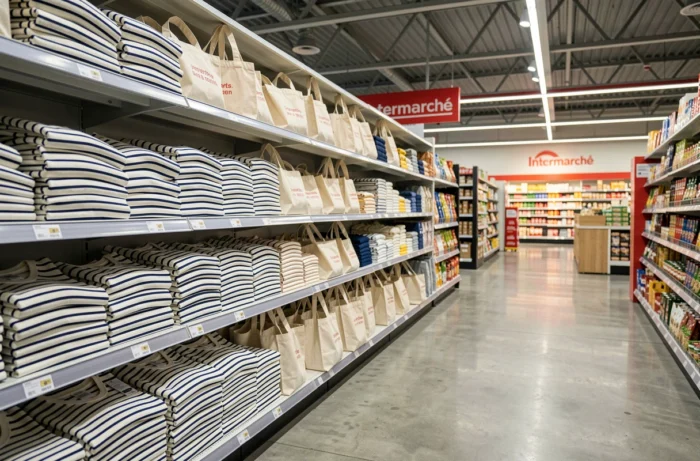
Armor Lux sticker operation: what the dual promotional mechanism changes
The 2026 edition is not limited to the simple accumulation of stickers. At certain times during the campaign, heavily discounted vouchers circulate alongside Armor Lux stickers. This overlap creates an opportunity window for attentive customers, but also a source of confusion.
Specifically, a customer can accumulate stickers on their card while benefiting from a one-time voucher in another aisle. The two mechanisms do not cancel each other out. They coexist on the same receipt.
The problem is that neither Intermarché nor Armor Lux communicates clearly about the timing of these additional vouchers. Customers often discover their existence by chance, at checkout or through online sharing groups. This opacity penalizes online shoppers, who do not have visibility on promotions displayed at the front of the store.
Resale and donation of stickers: a revealing parallel market
A related phenomenon illustrates the gap between perceived value and actual value of the operation. Armor Lux stickers are exchanged on donation and resale platforms like Geev. Some customers who do not wish to complete their booklet sell their stickers, while others actively seek them out to reach the required threshold without making multiple trips.
This informal market raises a question that official communication sidesteps: if the system were perfectly clear and accessible, would these exchanges exist in such proportions?
Armor Lux stock at Intermarché: why some items disappear within weeks
Stock management is the most documented point of friction based on customer feedback. Each Intermarché store manages its own supply of Armor Lux products. There is no centralized stock or online reservation system.
The concrete consequences for the customer:
- The most sought-after items (beach towels, foutas) may be sold out in some stores within the first weeks of the operation, well before the end date of August 2
- A store in a coastal area faces demand pressure much higher than a retail outlet in a rural area, with no visible adjustment of allocated volumes
- The online customer who has patiently accumulated their stickers for several weeks may find an empty stock at the time of pickup, with no alternative offered
No compensation mechanism is provided in case of stockouts on the chosen item. A filled sticker booklet does not entitle the customer to an equivalent voucher or a carryover to a future operation.

Intermarché loyalty card and stickers: the condition many discover too late
The Intermarché loyalty card is not just a bonus in this operation. Without an active card, no stickers are credited, whether the purchase is made in-store or online. This prerequisite, although structural, is not always clearly visible in the promotional communication at the store entrance.
For customers using the Intermarché app, stickers are tracked digitally. For others, the paper booklet remains available at checkout. The two formats coexist but are not interchangeable: a customer who starts with the paper format and then switches to the app must ensure that their previous stickers have been properly transferred.
App or paper booklet: a choice that affects accumulation
The app offers a real advantage: real-time visibility on the number of stickers accumulated. The paper booklet, on the other hand, relies on the customer’s vigilance and on the cashier remembering to distribute the stickers. During busy periods, oversights occur.
Digital tracking via the app remains the most reliable way to avoid losing any stickers, particularly for customers who alternate between online and in-store shopping.
The Armor Lux operation at Intermarché operates on an attractive principle, but its actual execution conditions remain uneven depending on the shopping channel and the point of sale. Customers who anticipate stock constraints, verify the linking of their card, and monitor the windows of dual promotions are those who derive the most value. Others risk filling a booklet for an item that no longer exists on the shelf.