The Panier alone encapsulates a significant portion of the fantasies about Marseille. The oldest district in the city, nestled against the Vieux-Port, it carries a reputation for being a dangerous area inherited from another era, alongside a growing tourist presence. Measuring the gap between perception and reality requires looking at what the available data, field opinions, and recent transformations in the neighborhood indicate.
Crime in Marseille and the Panier: What Recent Figures Show
National data published in 2024-2025 indicate a decrease in burglaries across France, with marked regional disparities. Marseille remains associated with crime linked to drug trafficking, but this is concentrated in the northern neighborhoods, far from the alleys of the Panier.
For a visitor or a resident in the city center, the real risk boils down to petty opportunistic crime: pickpocketing, bag thefts on terraces, vehicle break-ins. This observation applies to the Panier as well as to the Vieux-Port, Cours Julien, or Notre-Dame-du-Mont.
| Type of Risk | Does it Concern the Panier? | Level for a Visitor |
|---|---|---|
| Organized Crime (drug trafficking) | No, localized in the northern neighborhoods | Almost none |
| Pickpockets and thefts | Yes, like any tourist area | Moderate |
| Targeted physical assaults | Very rare in the area | Low |
| Feeling of insecurity (narrow streets, degraded facades) | Yes, amplified by the old urban planning | High in perception, low in fact |
The question of whether the Panier neighborhood in Marseille is dangerous thus deserves to be rephrased: the perceived danger is more related to the visual ambiance of the neighborhood than to a proven statistical risk for those passing through.
Feeling of Insecurity in the Panier: Factors Distorting Perception
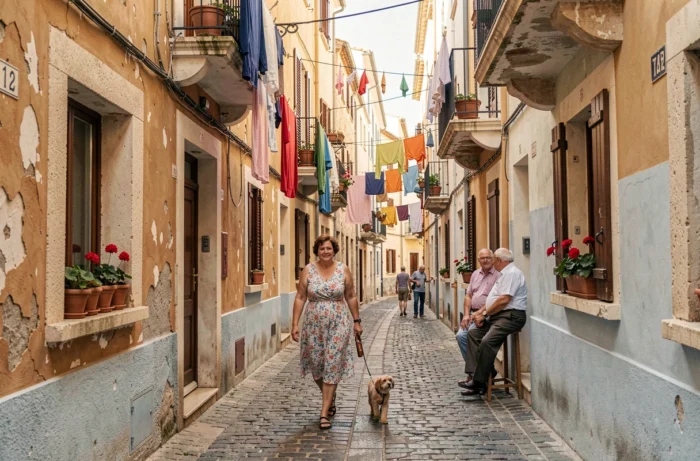
The Panier features an urban layout that fuels discomfort among visitors unaccustomed to Mediterranean cities. Narrow alleys, little natural light during the day, sometimes decrepit facades, laundry hanging from windows, covered passages: all of this contributes to a feeling of insecurity disconnected from statistical reality.
Research by the Quorum Institute on the gap between feelings of insecurity and crime statistics confirms a well-documented phenomenon in urban sociology: the perception of danger depends as much on the visual environment as on the facts. A clean and well-lit neighborhood appears safe even if crime figures are comparable to those of a neighborhood perceived as risky.
What Amplifies the Negative Reputation of the Panier
- The media coverage of Marseille focuses on settling scores related to drug trafficking, creating a conflation with the entire city, including the Panier
- Online reviews polarize opinions: on Tripadvisor, there are both “Excellent” ratings and alarmist headlines, without context or nuance
- The neighborhood remains lively and noisy in the evening, which unsettles visitors accustomed to more sanitized city centers
On the other hand, the strong presence of tourists during the day, the immediate proximity of the Vieux-Port and museums (notably the MuCEM) creates a constant flow that reduces opportunities for crime.
Airbnb and Tourist Regulation: A Game-Changer in the Panier
The Panier has undergone rapid transformation due to short-term tourist rentals. Residents report a neighborhood emptying of its permanent residents, replaced by transient travelers. This phenomenon has fueled a double complaint: loss of authenticity and degradation of the social bond that served as informal regulation.
Since April 29, 2025, regulations have tightened. Any short-term rental in Marseille requires a change of use authorization with compensation from the first rental. As of January 1, 2026, the rental cap for a primary residence as a short-term rental is reduced to 90 days per year, with a civil fine of up to 10,000 euros for exceeding this limit.
These measures, stemming from the Le Meur law of November 19, 2024, directly target hyper-touristic neighborhoods. In the Panier, the expected effect is twofold: to slow down the population turnover that destabilizes the social fabric, and to maintain a permanent residential presence that contributes to the neighborhood’s safety.
Concrete Consequences for the Neighborhood
The return of year-round residents to previously seasonal rental properties should restore a stable neighborhood. Local shops, which had given way to tourist boutiques, could regain a local clientele. The article from the academic media 13 Informé reports that most small businesses in the Panier have disappeared, replaced by snack bars or seasonal stalls that close for several months a year.
Living or Visiting the Panier: Important Reflexes
The Panier does not require different precautions than those one would take in any tourist district of a major European city. Feedback converges on a few simple points.
- Keep belongings close to your body on terraces and in crowded pedestrian streets, especially during cruise season (several ships per day in high season)
- Prefer busy streets in the evening rather than poorly lit side passages, as in any old town center
- Do not leave visible items in a parked vehicle near the neighborhood
These precautions are a matter of urban common sense, not a Marseille-specific issue. The Panier remains one of the most photographed and visited neighborhoods in the city, with a density of visitors that in itself constitutes a safety factor.
The gap between the reputation of the Panier and observable reality stems from a mix of inherited representations, distorting media coverage, and an urban layout that does not conform to the reassuring codes of renovated city centers. The available data and recent regulatory developments point in the same direction: the Panier is a vibrant tourist neighborhood, not a risk zone.