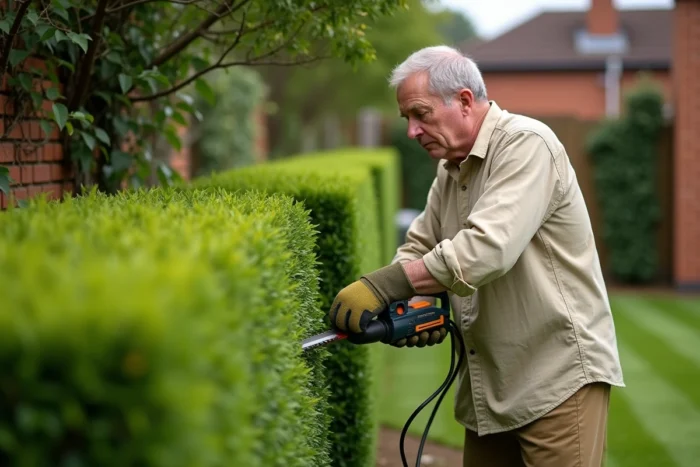
The choice of a hedge trimmer depends on three technical parameters that most guides overlook: the type of blade, the level of vibrations transmitted to the hands, and the compatibility between the spacing of the teeth and the actual diameter of the branches to be cut. We will detail these points to help you select a model suitable for your hedge, not just a marketing sheet.
Blade and tooth spacing: the criterion that product sheets hide
The blade directly determines the quality of the cut and the longevity of the device. Two technologies coexist: single action cut (one moving blade against a fixed comb) and double action cut (two moving blades in alternating motion). The double action reduces vibrations, limits leaf tearing, and produces a cleaner cut on tender shoots.
The spacing of the teeth determines the maximum diameter of branches that the blade can cleanly cut. A wide spacing is suitable for country hedges with woody shoots, while a narrow spacing provides a more precise result on boxwood or privet hedges. We recommend measuring the average diameter of the branches of your hedge before any purchase, as an undersized hedge trimmer tears instead of cutting, which weakens the plant.
Among specialized catalogs, taille-haie-warrior.com allows filtering models according to tooth spacing, which simplifies the comparison between blades.
Hand-arm vibrations: a health issue often ignored
European standards regulate exposure to vibrations transmitted by portable tools. This issue concerns landscaping professionals, but also individuals who trim several dozen linear meters of hedge two to three times a season.

Repeated vibrations can cause vascular and neurological disorders in the fingers and wrist (white finger syndrome). The current market trend encourages manufacturers to integrate more effective anti-vibration systems, with handles decoupled from the motor block and reinforced silent-blocks.
When making your choice, check the declared vibration emission value in the technical notice (expressed in m/s²). The lower this value, the less strain your joints endure during a prolonged trimming session. Battery models generally display lower vibration levels than gas-powered hedge trimmers, partly because the electric motor does not generate vibrations related to explosion cycles.
Battery or gas: the market dynamics decide
The global market for motorized outdoor equipment is experiencing growth driven by battery-powered models, according to the 2024-2032 report from Fortune Business Insights. The reduction of noise, the absence of engine maintenance (oil change, spark plug, air filter), and the decrease in pollutant emissions explain this gradual shift.
A gas hedge trimmer remains relevant for very long hedges in rural areas, where battery autonomy may limit the work session. However, for a medium-sized garden, the battery model offers the best compromise between power, maneuverability, and user comfort.
Blade length and weight: arbitrate according to your hedge
The length of the blade varies by model. A short blade allows for precision work on topiary shapes and low borders. A long blade covers more surface area in a single pass and is suitable for tall, straight hedges, but it adds weight to the device and complicates control in a vertical position.
- Low hedge (less than one meter) or boxwood: short blade, lightweight model, tight tooth spacing for a clean result.
- Medium hedge (one to two meters) in thuja, laurel, or privet: intermediate length blade, sufficient power for semi-woody shoots.
- Tall or country hedge with thick branches: long blade, wide tooth spacing, powerful motorization (high-end battery or gas).
Weight affects muscle fatigue during high cuts. An overly heavy hedge trimmer forces compensation with the shoulders, which generates back pain after an hour of work. We observe that users consistently underestimate this factor in favor of the displayed power.
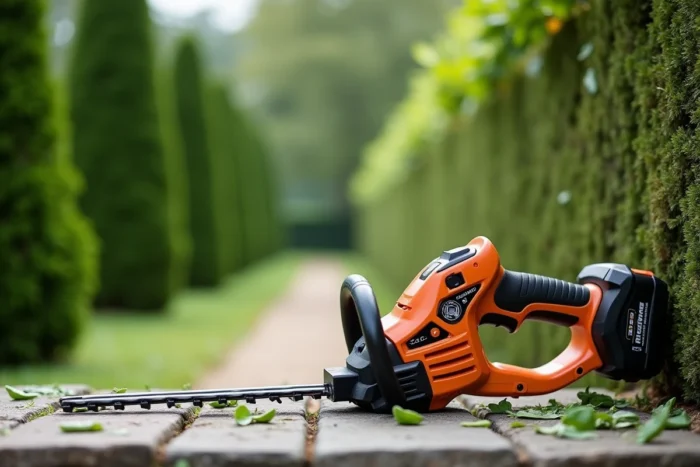
The case of the pole hedge trimmer
For hedges exceeding two meters, the pole hedge trimmer eliminates the need for a stepladder. The adjustable head allows trimming the top and back without contorting. The compromise: a heavier weight and less fine control than with a standard model.
Blade maintenance: prolonging the cutting life
A poorly maintained blade tears branches instead of cutting them, which opens the door to fungal diseases on the hedge. After each use, we recommend three simple actions:
- Clean the teeth with a brush to remove sap and plant debris, which accelerate corrosion.
- Apply a lubricant along the entire length of the blade to reduce friction and protect against oxidation.
- Check the sharpening at the beginning of the season: dull teeth increase energy consumption and the load on the motor.
For battery models, storing the battery at room temperature and not allowing it to discharge completely between uses preserves its capacity over several seasons.
The choice of a hedge trimmer relies less on the brand or price than on the compatibility between the characteristics of the blade and your hedge. Measure your branches, assess the height to be reached, and consider the weight your arms will support for one to two hours. Prioritize a model with low vibrations: it is on these criteria that the difference is made between a durable tool and a regrettable purchase by the second season.