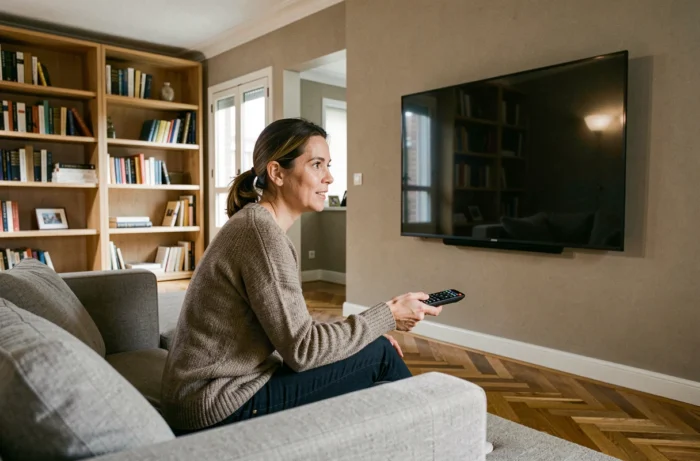
The 2026 return of French television is taking place in a realm that program schedules do not reveal: the shift in reception modes. DTT is no longer the main channel for just over a third of households. The rest access content through operators’ IPTV, connected devices, or directly via channel apps on smart TVs.
This technical shift alters how viewers discover new content, and especially how broadcasters schedule their event evenings.
TV Reception in France: The End of the DTT-Centric Model
We have observed a clear decline in terrestrial DTT as the main entry point to channels over several seasons. Telecom operators (IPTV boxes) and connected TVs now capture the majority of usage, redistributing the cards for publishers.
This change is not cosmetic. When a household accesses television via a box or smart TV, the interface mixes linear channels and platform catalogs on the same home screen. Traditional channel surfing is declining in favor of thumbnail navigation, similar to that of Netflix or Prime Video. Channels that do not optimize their presence on these interfaces lose visibility, even with a solid schedule.
For industry professionals, the direct consequence affects audience measurement. Médiamétrie is gradually integrating IPTV and OTT streams into its panels, but the connection with historical DTT data remains imperfect. Advertisers and advertising agencies are therefore working with indicators in transition, complicating the management of campaigns during prime time slots. The resources offered by Dv Télévision allow for tracking these technical evolutions throughout the seasons.
Decline in Replay, Rise in Streaming: Decisions for the 2026 Return
The replay of traditional channels recorded a significant decline in the first quarter of 2026, around seven percent in terms of hours viewed. This decline does not indicate a disinterest in programs, but a shift in usage towards SVOD platforms.
About two-thirds of French households combine linear television and at least one streaming platform each day. A typical evening is organized around a news broadcast or live entertainment, followed by a series on Netflix, Disney+, or Prime Video. This dual usage, often on the same television, makes the boundary between “television” and “streaming” increasingly artificial.
What This Means for Fall Schedules
Channels are concentrating their resources on two time slots where linear programming retains a structural advantage: live events (sports, flow entertainment, election nights) and well-known heritage fiction. Formats that worked in replay, such as magazines or late-night documentaries, are migrating to the digital hubs of the groups (france.tv, TF1+, M6+).
- Live flow entertainment remains a pillar of weekday evenings, capitalizing on simultaneous viewing and social media.
- French prime-time fiction focuses on event mini-series of four to six episodes, a format designed to generate buzz over one to two weeks rather than stretching over months.
- High editorial-investigation documentaries (drug trafficking, news stories, societal investigations) constitute the third pillar, with productions like Narcorama on France Télévisions targeting both linear and digital catalogs.
La Rochelle Fiction Festival 2026: Key Signals to Note
The La Rochelle Fiction Festival remains the most reliable barometer for anticipating trends in the upcoming season regarding French series and TV films. The 2026 edition highlighted several productions that illustrate the current directions of broadcasters.
Short formats and mini-series dominate the selections, confirming that channels prefer closed narratives rather than open-ended seasons. This logic directly responds to the competition from platforms: a viewer accustomed to binge-watching an entire season over a weekend is no longer willing to wait eight weeks for a weekly soap opera.
These fictions share a common trait: rising unit budgets, driven by the need to visually compete with SVOD productions. The average cost of a prime-time French fiction episode has significantly increased in recent years, pushed by technical requirements (shooting in 4K HDR, immersive sound post-production) and competitive salaries for creative talents.
Fall Audience Figures: What the Initial Numbers Reveal
The gap between audience successes and failures is widening in the 2026 return. Programs that succeed share three characteristics:
- A high-profile cast that generates press coverage and social media sharing even before airing.
- A clear editorial positioning, identifiable in one sentence, which facilitates algorithmic recommendations on box and smart TV interfaces.
- Immediate availability in replay or digital preview, to capture viewers who no longer watch in linear flow.
The daily video consumption of the French remains high, with a dominant share still captured by linear television. The challenge for channels is no longer to fight against streaming, but to integrate their content into an ecosystem where the connected television is the central hub. The 2026 fall schedules reflect this reality: fewer slots to fill, more programs designed as events.