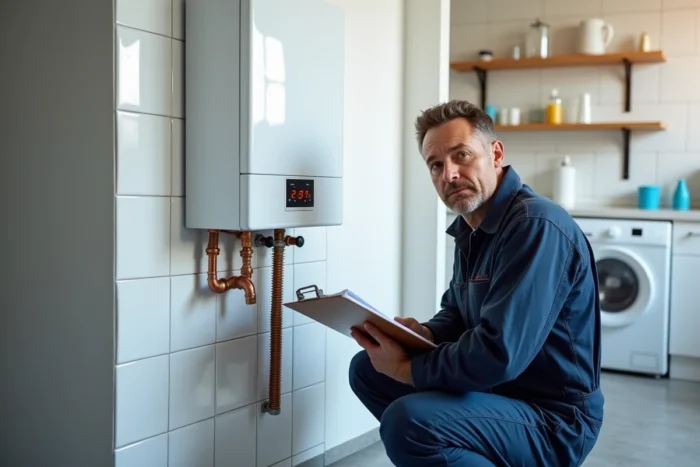
Replacing an aging boiler with a modern model is often the expense that causes the most hesitation. The purchase price matters, but the gas bill over ten or fifteen years weighs much more heavily. To navigate this, you need to compare what each technology actually brings to daily life, without being impressed by technical specifications.
Efficiency and condensation: what really lowers the gas bill
Have you ever noticed steam coming out of a chimney in cold weather? This water vapor contains energy. A conventional boiler lets it escape. A condensing gas boiler recovers this latent heat from the flue gases to preheat the return water from the heating circuit.
In practical terms, this means it consumes less gas to produce the same amount of heat. This is why condensing models have efficiencies that exceed those of conventional or low-temperature boilers.
Before consulting a comparison of gas boilers with the best value for money, keep in mind that the actual efficiency depends on the return water temperature. If your radiators operate at low temperature (underfloor heating, oversized radiators), condensation occurs fully. With older radiators that run at high temperature, the gain decreases.
Wall-mounted or floor-standing boiler: which format for which home
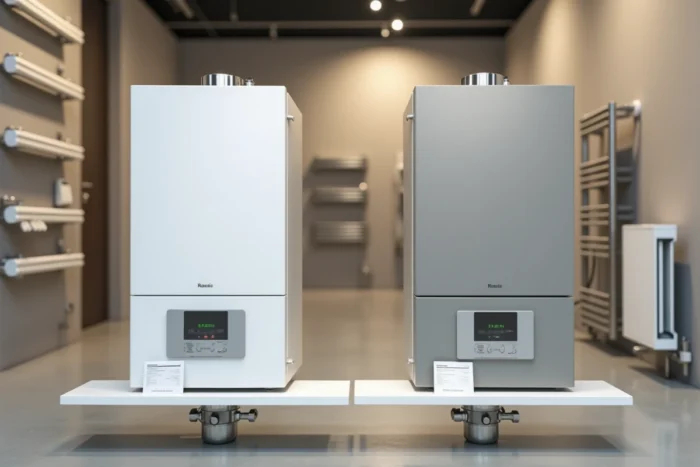
The choice between a wall-mounted boiler and a floor-standing model is not just about aesthetic preference. It depends on the area to be heated, the need for hot water, and the available space.
A wall-mounted boiler is installed in a kitchen or technical closet. It is suitable for apartments and medium-sized houses. Its power meets most common heating and hot water needs.
A floor-standing boiler is aimed at large areas or high hot water needs, for example, a house with several bathrooms. It takes up more space, costs more to purchase, but offers a higher power reserve.
Why does this choice matter for value for money? Because an oversized boiler consumes more than necessary, while an undersized model wears out prematurely. The match between the format and the home determines long-term profitability.
Concrete selection criteria for good value for money
Rather than comparing dozens of models, focus on four parameters that truly differentiate the models.
- The type of service: single service (heating only) or double service (heating and hot water). A double service model avoids the purchase of a separate tank but costs more upfront. If you already have a water heater in good condition, a single service is sufficient.
- The energy class and seasonal efficiency: class A or higher ensures that the condensation works efficiently. Check the energy label rather than the efficiency stated on the sales brochure.
- The availability of spare parts: a cheap boiler whose parts are unavailable after five years ultimately costs a lot. Favor brands that have a maintenance network in France, such as Saunier Duval, Elm Leblanc, Frisquet, or De Dietrich.
- The compatibility with your existing installation: hydraulic connections, condensate drainage, type of flue. A compatible model without major adaptation work reduces the overall project cost.
The trap of the catalog price
The displayed price of a boiler represents only part of the budget. The cost of installation by a qualified RGE installer is as important as the equipment. Two quotes for the same model can vary significantly depending on the complexity of the connection and the region.
Always request a detailed quote that separates the equipment, labor, and any adaptation work (flue lining, creation of a condensate drainage). It is the total installed cost that determines the true value for money.
Gas regulation: what changes for buyers in 2025-2027
If you buy a gas boiler today, you are purchasing equipment whose regulatory framework is evolving rapidly. Two deadlines change the game.
Since January 1, 2025, 100% gas boilers can no longer be installed in new condominiums. This restriction does not affect the existing stock or individual houses, but it signals the direction taken by the regulations.
The electrification plan presented on April 10, 2026, goes further: any gas installation will be banned in new constructions for which the permit is submitted from January 1, 2027, including hybrid systems combining a heat pump and a gas boiler.
Are you renovating an old property? The condensing boiler remains a legal and relevant option. However, if you are building or planning a major renovation with a change of permit, the regulatory trajectory points towards other solutions.
Is it still worth investing in a gas boiler during renovations?
For an existing property connected to the gas network, replacing an old boiler with a modern condensing model often remains the most rational choice. The efficiency gain is immediate, the installation relies on the existing circuit, and the budget remains contained compared to a heat pump.
The profitability horizon generally lies over the lifespan of the device. As long as the gas network supplies the property, the boiler operates. The real financial risk would come from a prolonged increase in gas prices, which would erode the savings made on efficiency.
Choosing a gas boiler in 2024-2025 means balancing a controlled entry cost with a tightening regulatory context. For a replacement during renovations, condensation remains the technology that offers the best balance between performance, installed price, and compatibility with existing circuits. Take the time to compare complete quotes, not just catalogs.